
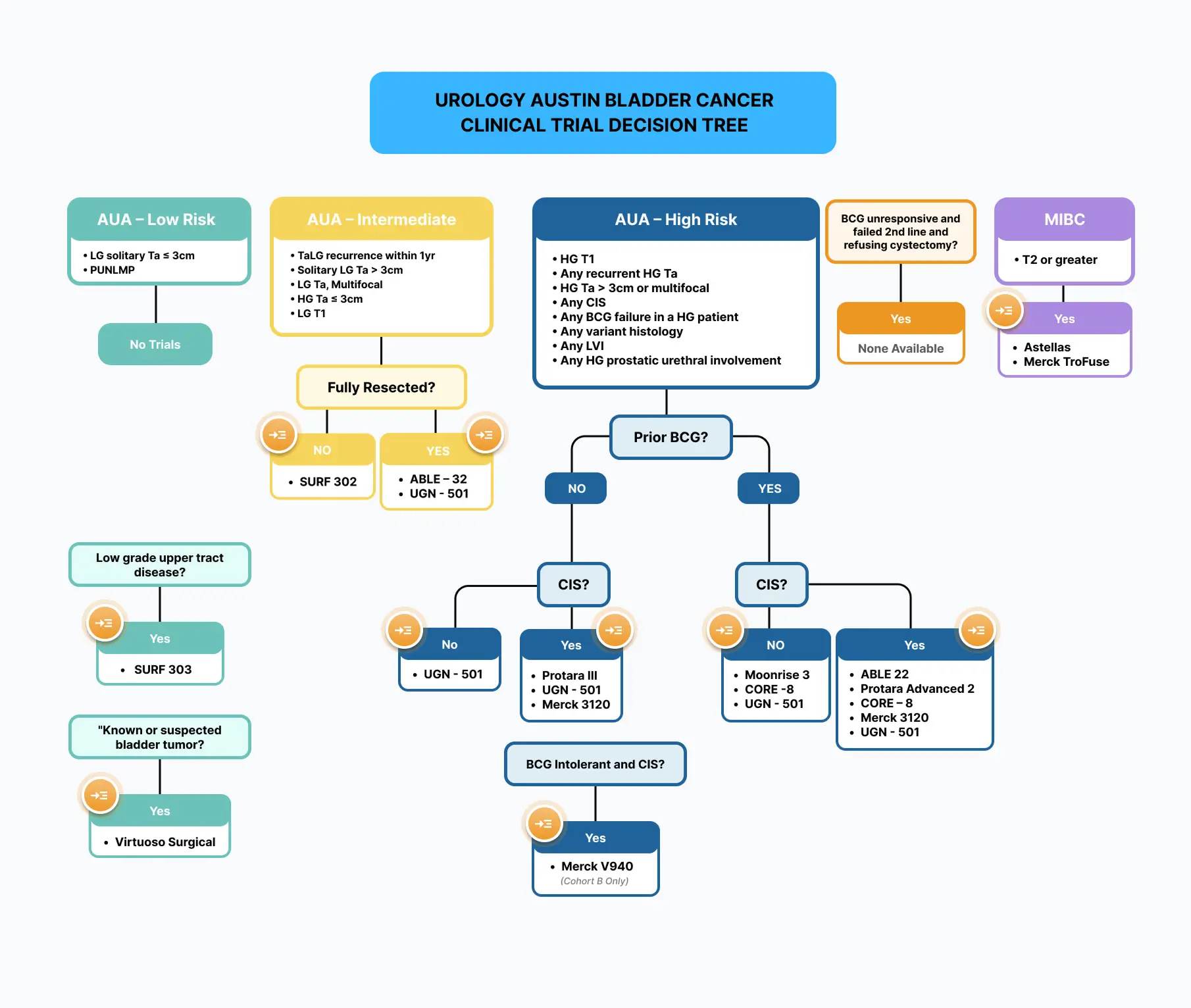
Explore Bladder Cancer Studies
Virtuoso Surgical
Patients with a known or suspected bladder tumor planned for a TURBT will be enrolled and treated with the Virtuoso Endoscopic Surgical (VES) system – an endoscopic robotic placed transurethrally and allowing en-bloc tumor resections
Suspected Bladder Tumor
ABLE-32
AUA IR NMIBC (including HG <3cm) will be randomized to Adstiladrin (intravesc 1x q3mo) vs observation. Patients on observation who have an IR recurrence can crossover to treatment.
SURF 302
Ablative therapy trial for patients with LG IR NMIBC. All patients must have 3-12mm of remaining tumor, have current proven LG disease, test FGFR+ on current or previous path. Patients will be treated with Dabogratinib, an oral FGFR inhibitor.
UGN-501
A Phase 1, Open-Label, Dose-Escalation, Multicenter Study to Investigate the Safety, Tolerability, Immunogenicity, and Pharmacokinetics (PK) of UGN-501 Intravesical Solution in Participants with Recurrent Non–Muscle Invasive Bladder Cancer (NMIBC).
AUA-Intermediate
Moonrise 3
BCG exposed, unresponsive, or intolerant pure papillary disease. Must test FGFR positive. Patients will randomize to TAR-210 (pretzel device) with Erdafitanib (FGFR inhibitor) exchanged q3mo vs intravesical chemo induction and q1mo maintenance.
ABLE 22
A phase 2, randomized, multi-centre, open-label trial to evaluate the safety and efficacy of intravesical nadofaragene firadenovec alone or in combination with chemotherapy (gemcitabine and docetaxel) or immunotherapy (pembrolizumab) in subjects with high-grade Bacillus Calmette-Guerin unresponsive non-muscle invasive bladder cancer
UGN-501
A Phase 1, Open-Label, Dose-Escalation, Multicenter Study to Investigate the Safety, Tolerability, Immunogenicity, and Pharmacokinetics (PK) of UGN-501 Intravesical Solution in Participants with Recurrent Non–Muscle Invasive Bladder Cancer (NMIBC).
Protara Phase III
BCG naïve (or no BCG in last 2yrs or 2 or fewer doses of BCG in the last 2yrs) CIS +/- papillary disease. Patients are randomized to TARA-002 (which is similar to BCG but composed of strep pyogenes) vs intravesical chemo – both given via induction and maintenance. Crossover allowed.
CORE-8 (Paused Enrollment)
Cohort B – HR BCG exposed patients with CIS or papillary disease, all patients will have Cretostimogene
Protara Advanced 2
BCG unresponsive (by the FDA definition, must have had at least 5 of 6 induction rounds and 2 of 3 maintenance or 2 of 6 reinduction) CIS. All patients will have TARA-002 which is similar to BCG but composed of strep pyogenes – given via induction and maintenance.
Merck 3120
Intravesical therapy MK3120 for patients with a history of T2, T3, T4 or metastatic UC.
AUA - High Risk
CORE-8 (Paused Enrollment)
Cohort B – HR BCG exposed patients with CIS or papillary disease, all patients will have Cretostimogene
UGN-501
A Phase 1, Open-Label, Dose-Escalation, Multicenter Study to Investigate the Safety, Tolerability, Immunogenicity, and Pharmacokinetics (PK) of UGN-501 Intravesical Solution in Participants with Recurrent Non–Muscle Invasive Bladder Cancer (NMIBC).
BCG Intolerant and CIS
SURF 303
Patients with biopsy proven LG UT disease, must have 5mm of remaining tumor in the upper tract (inclusive of the ureters) and FGFR status will be checked, but is not required for inclusion. All patients will have oral Dabogratinib and q3mo surveillance URS.
Low grade upper tract disease
Astellas
T2-T4 UC patients will receive 4 cycles of Enfortumab Vedotin and Pembro (EV-P) and then will be assessed via imaging, cysto, cytology. Patients with a complete response or downstaging will have 5 more cycles and ongoing surveillance. Non-responders will be recommended for cystectomy or other SOC.
Merck TroFuse
T2-T4 UC patients who elect a bladder sparing approach will be randomized to chemo/radiation +/- the combination of sacituzimab/pembrolizumab. Patients in the investigational arm will have consolidation pembro during/after chemo/radiation. All patients will have a cysto/biopsy 8 wks after radiation and then q12wks for 2yrs.
MIBC